America and Israel are at war with Iran for three reasons.
First and foremost, is to protect the petrodollar and by extension, the dollar as the world’s reserve currency. The word “petrodollar” means nothing to the average American. But what it refers to is the exchange between oil for U.S. Dollars – not oil for yen, or pesos, or pounds, or euros, but dollars. Starting in 1974, Washington and Riyadh (of Saudi Arabia) built an interlocking set of deals: the U.S. would supply arms and military protection; the Saudis would price their oil in dollars and funnel the windfall back into U.S. Treasury bonds — a secret arrangement not publicly confirmed until Bloomberg obtained the documents via FOIA in 2016.
How does America benefit from that? It benefits because, as introductory neoclassical economics indicates, higher demand means higher prices. And the dollar itself has a price. If your currency is “weak” that means it can’t buy much. It’s inflated. If your currency is “strong,” that means you can buy a lot. It’s not inflated.
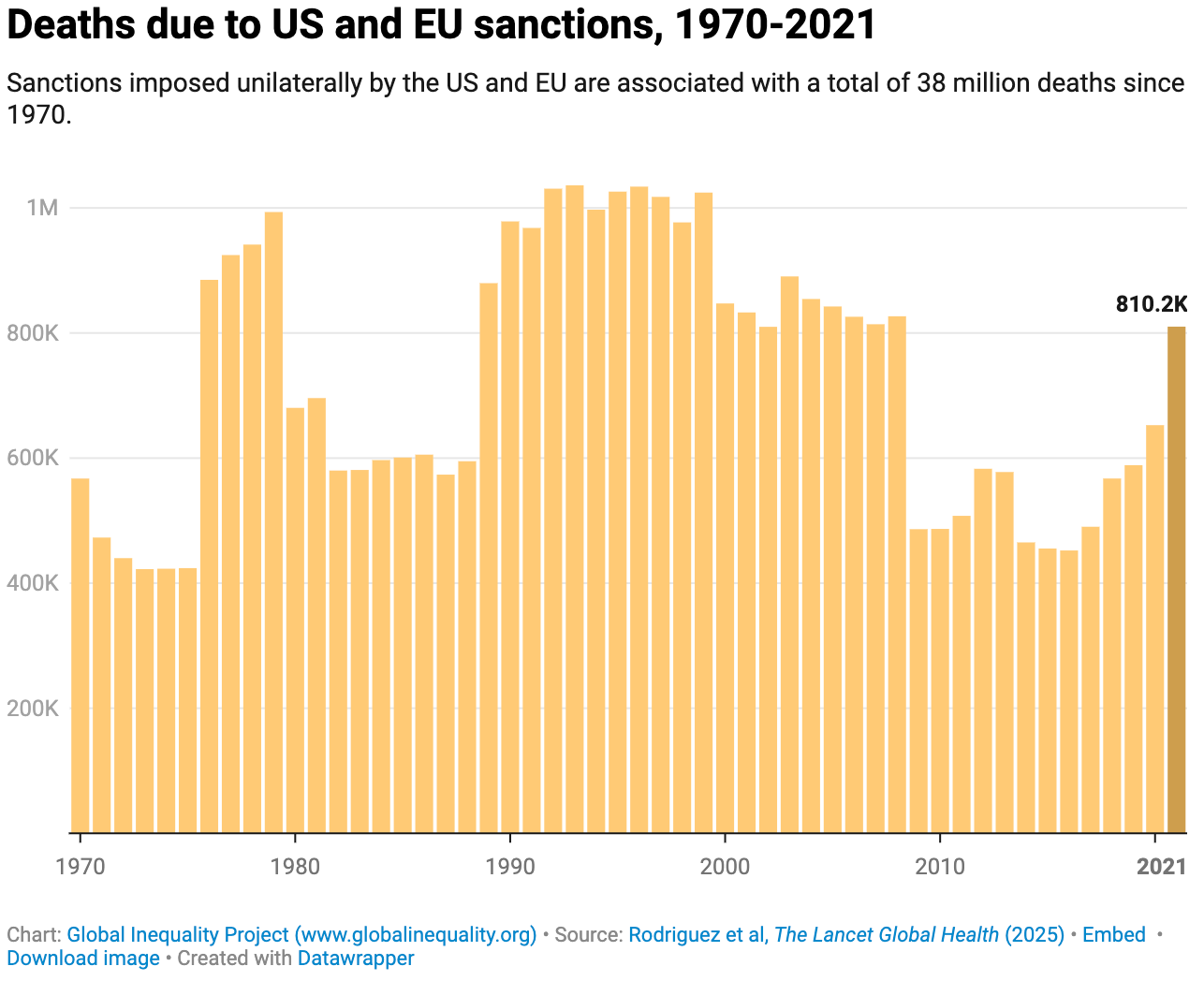
The American empire has sustained power over the decades, through trials and tribulations, because of a strong dollar that is in high demand. (That was the purpose of the post-WWII Bretton-Woods system.) It can print money by typing numbers in a computer at the Federal Reserve and use that to spend on things like the largest military on earth without worrying about hyperinflation. The United States could not afford its military and would probably suffer from hyperinflation without countries selling oil in the dollar. That’s largely why the U.S. overthrew Libya and Iraq and other countries in the Middle east: they wanted to own their oil for their own people/governments and sell in other currencies. The U.S. said “not on my watch,” and destroyed them, privatized the oil, and continue to sell it in dollars. This, combined with American and European sanctions against other countries for similar reasons, is nearly a century-long campaign and is insanely devastating. (All of it is justified in the name of “national security,” “fighting terrorism,” etc.)

Iran is outside the petrodollar. Iran generates massive amounts of oil that is not owned and controlled by American and British oil companies, and sells its oil for different currencies. For the aggressive American empire, it must therefore be overthrown like any other country that tries to operate independently from Washington D.C.
The dollar also serves as the world reserve currency: it’s what banks around the world keep in their vaults and accounts. If the dollar starts to fail, banks around the world will look towards a different global reserve currency. (This will happen no matter what the US does, FYI. But all empires are delusional and believe they are eternal.)
Second, American and Israel are at war with Iran to destroy all resistance to Israeli settler colonialism. Israel, like the early United States, is an expansionary settler colonial project: it was created by European nationalists to establish an ethnostate by stealing and conquering land, and in the process, “had” to commit genocide against indigenous peoples. (For Turtle Island, the victims were Native Americans. For Palestine, the victims are Palestinians.) Israel is explicit about its goals to create “Greater Israel” and expand beyond even its current illegal borders. That means conquering Lebanon, Syria, Jordan, parts of Iraq, Egypt, etc. Most of these countries have already been subordinated to Israel through puppets, which were installed to allow Israel to control these countries. Jordan, for example, is a proxy that will do whatever the Pentagon says. (They don’t want to get bombed like the others! The record-breaking destruction of Gaza is now a warning to everyone!)
Israel continues to bulldoze homes in Palestine (the West Bank and Gaza), recently evicted 700,000 people from Lebanon (which is like emptying the entire state of South Dakota), and continues to conquer land in Syria as well. It as no intention of stopping. Settler colonies do not wake up one day and say “hey we should stop this; we can’t conquer the whole world.” They are inherently aggressive, so they only stop when something or someone makes them stop.
Iran funds the resistance to Israeli settler colonialism. It provides arms and funds to Hezbollah in Lebanon, the Houthis in Yemen, and to Hamas in Palestine. So, if Israel wants to conquer much or all of the Middle East (and beyond; the Roman Empire and British Empire started very small!), it has to eliminate resistance. That means Iran must be conquered like everyone else.
Third, Persia (or today, “Iran”) is the gateway between East and West and is serving as a competing ground between the U.S. and China.  (There’s a brilliant work on the history of Persia everyone should read called The Silk Roads: A New History of the World. It’s a marvelous history of Persia in a non-eurocentric lens by an Oxford professor; easy to read and fascinating.) China is generally not a “threat” to anyone who is peaceful. While Tibet, Taiwan, and the northern province of Xinjiang are somewhat exceptions, China is not an expansionary empire. Their Belt and Road initiatives of providing infrastructure and trade routes across Asia do not operate on the basis of dropping bombs. (China hasn’t dropped a bomb in nearly 40 years – while America drops 40 bombs per day on average since 2001.) When countries decline offers, China says “Ok, let’s negotiate a better offer,” not “Ok, we’re going to bomb the snot out of you and make you and your whole society scream until you agree.” (“Make the economy scream” is an imperialist line from Richard Nixon on overthrowing Chile). China is also competing with America as an industrial power, just like Germany and NotGreat Britain in the early 20th century, which led to World War I. America cannot manufacture what China can, nor at the rate and prices that China can. It won’t ever be able to for probably several decades. The U.S. had an edge on education and innovation, but Trump has been cutting research left and right. And the AI datacenters are a disaster on so many levels. (China’s technology is more efficient and open source, while OpenAI drags taxpayers down with ludicrous Pentagon and government contracts to build obsolete datacenters.)

Important works like Eric Reinert’s book How Rich Countries Got Rich…and Why Poor Countries Stay Poor demonstrate the importance of industry (not to be confused with “capitalism”). He shows that it is actually better to have an industrial and manufacturing sector that is inefficient and inferior than to have none at all. Having no such sector means you’re at the mercy of importing so many goods, and have a serious national security issue. His book also shows that when financial powers and industrial powers compete, industrial powers always win.
There’s not much America can do to stop China’s ascent – which wonderfully pulled 700 million people out of poverty in just 20 years; it is possibly the greatest economic accomplishment ever recorded. But it can sanction Iran (which has been devastating). It can bomb all of China’s strategic trading partners with insanely expensive weapons, and try to isolate China’s web of global trade…but with about as much success as catching rain with your hands.

Iran is a significant trading partner of China (and Russia), including for oil. But it is also a geographic place for Chinese trade development: the Belt and Road Initiative goes straight through Iran to Turkey. Thus, the reasoning goes, destroying Iran’s ability to sell oil and development new infrastructure hurts China.
This, however, is like a two-move strategy in chess. That’s going to get you to tomorrow, but it’s not enough to win. There are endless strategic problems that arise at this point, but here are the big ones:
- The cost of maintaining dominance over Iran. The American military was not mean to win wars, but to profit investors. An insane amount of money was spent just in the first three days of America’s attacks of Iran. The U.S, cannot survive this war even with the largest military budget in human history. The math don’t work.
- The risk of going to war with China and Russia (and any other trade partners of Iran). Today in 2026, there is probably less than a 30% probability that the U.S. would survive a war with China alone, and less than a 10% chance that it would win a war with China and Russia. It is now likely that the U.S. will deploy troops to Iran, and that will be a catastrophic disaster largely because of geography. (Iran is one of the few places on earth that has resisted colonization partly because of geography; it is also heart-breaking not only to witness the human and animal deaths, but the destruction of historic architecture).
- The destruction of existing trade relationships with the United States. Iran is integrated into the world trade system. When America starts bombing oil tankers and conquering countries, other countries take note. They cancel contracts. Change their commercial insurance policies. Development alternative partnerships. They will gradually, or quickly, agree to let America isolate itself. This antagonism hurts the U.S. economy and its investors even more.
- The destruction of the global economy. As I type this, the oil shock caused by American attacks is the greatest on record. “About 20% of global supply has been disrupted for nine days, more than double the previous record set during the Suez crisis of 1956.” Crude oil futures markets have traded at over $118/barrel in a matter of days and gas prices have gone up significantly across the globe. Israel and the US assassinated one of the most lenient and moderate leaders of Iran who is now replaced by an heir that is more radical and less willing to negotiate. (Though his terms for negotiation are very reasonable!) This means the Straight of Hormuz will likely be closed long enough to cause a global recession on the scale of the 2020 COVID era. (Indeed, Iran is laying mines. And Trump capitulated to buying Russian oil today.)
So, the irony is clear: by trying to conquer Iran, the United States will hurt itself significantly in all of the areas it wants to dominate. Because of significant costs, an unwilling and discouraged population and waning armed forces, and a discredited government ran by child rapists, it may lead to a significant disintegration of the empire itself.
This is precisely why so many previous presidents refused to invade Iran even when Israel and western companies tried to force them into it. It’s just too risky and too intertwined with other contingencies.
But, why now?
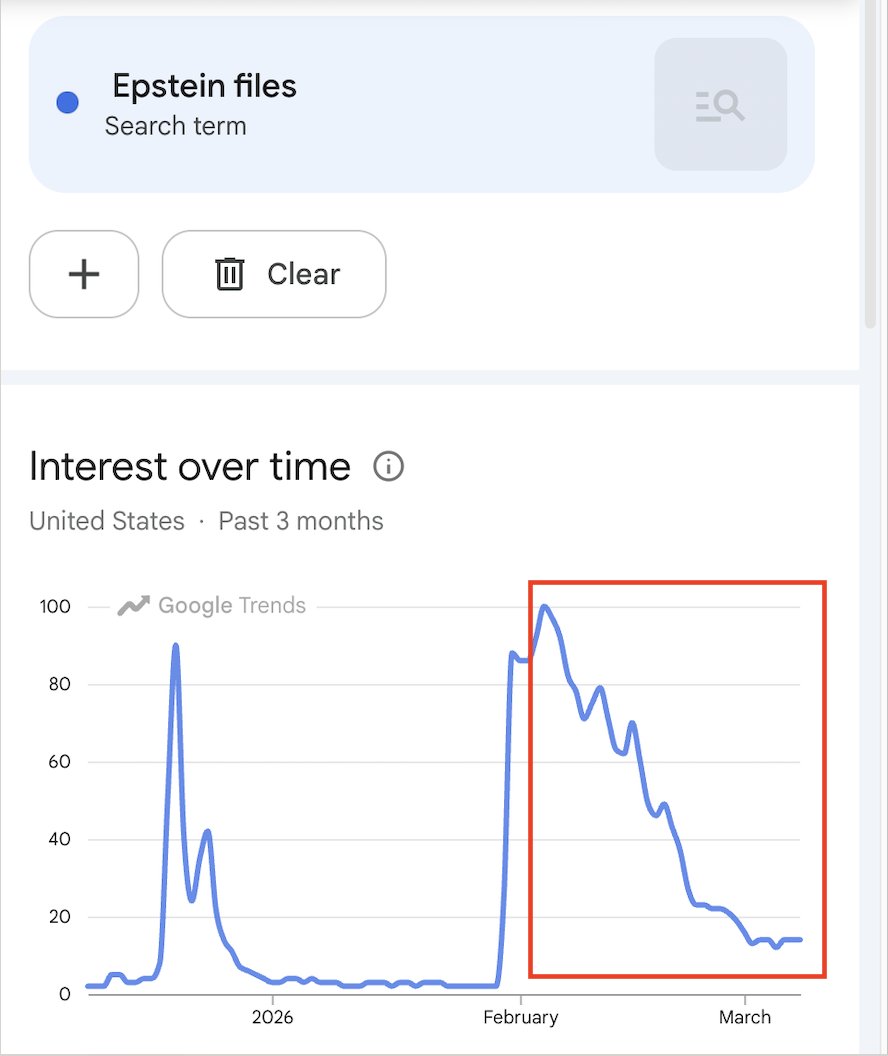
For three reasons: (1) Iran is at its weakest due to American sanctions (see graph above; (2) Trump is a tool in Netanyahu’s hands, and with Trump in office, now is the ultimate chance to use American troops to defeat Israel’s Biggest Obstacle towards full control of West Asia; (3) the Epstein files are so damning of Trump and are hitting mainstream very hard and causing serious trouble with the billionaire pedophile network at large; a distraction is much welcome.