I’m consolidating my “summer update” with this “fall update.”
Years ago I was approached to write a chapter on the meaning of life for a prestigious academic publisher (Brill). Now, three years later – about 2.5 years after I submitted the project with unusual (usual) editorial nightmares – the final article was sent to me this past July as “Jamin Andreas Hübner, “Metaphor, Meaning, and Religious Discourse: A Linguistic and Theological Archeology of the ‘Liquidation of the Human Spirit’,” in Travis Meyers and Kirk Lougheed (eds.), Religious Faith and Meaning-Making (Cham: Palgrave MacMillan, 2026), p. 203-246. Kirk was my boss at LCC; Travis a colleague there as well.
Despite the delays and formatting/editorial issues, and nearly forgetting I had written this thing, I’m actually generally OK with this work of philosophical theology – something I rarely write about anymore. It allowed me to zoom out and try to answer one of the hardest questions I know of: What does it mean to have meaning in life and what role has religion played? Why is life so meaningless today?
I try to address this gigantic existential subject with a somewhat narrow lens: modern linguistics and cognitive science of religion, the work of Owen Barfield, and the constructive Christian theology school of Vanderbilt Divinity School. I felt like those were some of the best places to answer these questions. The chapter is dense and not at all light reading (😆) , but I think compelling and interesting to read, especially if you’re lost with regard to the purpose and function of religious discourse. (Who would have thought that “pray harder,” “read your Bible,” “go to church” worked for kids but doesn’t work for most adults?) (Fair warning though: I highly doubt reading this article will give your life meaning; so don’t come with that expectation😊.)
As I approach 40 years of age, I find that most people become less overtly religious while a handful turn inward and became more irrationally and fanatically religious. In my chapter, I grieve and warn about both secular and religious fundamentalisms – both which (to use Barfield’s language) “liquidate the human spirit” by eradicating the language and metaphors that make life meaningful.
I’m more personally annoyed at religious fundamentalists since I’m more intimately acquainted with that destructive force. And I also find it more damaging to society, human and animal relationships, and the natural world in general than the handful of angry atheists in their 20s who read Sam Harris uncritically. Much of this fact has to do with who occupies offices of political power, and the power socially given to right-wing religious institutions – whether Hindu in India, evangelical in the U.S., Islamic in Saudi Arabia, or whatever. It doesn’t have to be that way, but unfortunately it is.
As I write elsewhere in my book Religion and Cooperative Economics, religion is neither inherently good or bad. “Good religion is good, bad religion is bad.” As it turns out though, I think most religion today (or rather, in the past 3,000 years) is the bad kind and so I’ve distanced myself from such enterprises and projects, while being very selective of any kind of involvements. (I support interfaith efforts, for example, largely because they create mutual understanding, prevent violence, and lead to peace.) My chapter speaks to that minority of what might be called “good religion,” and tries to explain what makes it valid and good – which is largely its capacity to make meaning through language (or what Barfield calls “expansion of consciousness”), reduce suffering (less emphasis), and also create ethical outcomes. This was always religion’s vital capacity – but it regularly gets co-opted in history, even if in some cases the religious tradition in question was at the same time inherently irrational or based on certain delusions (or rather, has a higher delusion tolerance, since human consciousness and activity actually requires some small degree of accepted delusion; there is no “purely and objectively rational” even in theory, since theories are created by conditioned subjects).
I think the main take-away I want readers to have, however, is a narrative: that life feels more meaningless today because of decisions made by others centuries ago (which made the world we now live in), which seeps down into our very words and conversations. It’s also because of the challenges of modernity – exposure to worldwide violence, neoliberal capitalism, etc.
Note that Claar and Forrester in another monograph by Palgrave (The Keynsian Revolution and Our Empty Economy: We’re All Dead – I envy this subtitle) address the same problem, but make the conservative impulse that I explicitly reject: circle the wagons around the ole western theistic worldview; after all, if it created meaning in the past, it can today! I argued elsewhere (in Faith & Economics) that this is specifically misguided and overstated. I also argue in Deconstructing Evangelicalism that this fails the “Business Innovator’s Dilemma”; assuming that past performance ensure future success. Religious worldviews either have to evolve and pivot radically (Jesus seemed to get that), or be created whole-cloth, if they are to do their own jobs. People get weird about “creating new religions” and I get that (most are cultish), but we have to understand that people do it regardless if its engineered and intentional.
(Related video here:
)
Humans don’t stop pursuing meaning, creating ritual, and constructing new discourses and words anymore than they stop drinking water. This may not result in a familiar organized religion (the anthropologists see baseball as highly religious, for example, Kottak 2026; Mirror for Humanity, 203, “Baseball Magic”), but I see no point in arguing against intentional reconstructions. Yes, many caves, trees, and forests served as natural homes for people for millions of years, but this doesn’t mean creating houses from blueprints is wrong or any less “natural” for people. *We end up living somewhere anyway* So we should – and many of us are are – becoming more honest and transparent about our meaning making, to whatever degree this is “religious” or not. As I write in my chapter, there are now more witches in the United States than Presbyterians. From my perspective, this is neither inherently good or bad, it all depend on what kind of world this creates.
Official chapter page is here: https://link.springer.com/chapter/10.1007/978-3-032-09479-7_10
~
Oxford University Press recently published my annotated bibliography for the entry “Cooperative Economics.” Another big project with a long, long delay! This one was quite fun though, and I’m glad it turned out satisfactorily. It was one of the few projects where the general editor had no comments.
This past spring I presented the inaugural text of my 400 page work ,”An Ecosocialist Constitution” at the 3rd Renaissance in Economics conference. (It was the most disorganized conference I’ve been to and the least favorable presentation environment I’ve ever experience…but regardless). I could go on and on about this one. So I won’t get started. It’s incomplete, but I hope to have it finished within a year after many peer reviews from colleagues I have yet not met. I hope it will become the gold standard for constitutional law and all future constitutions on this planet – a template for reference, not necessarily enacted as-is anywhere. If you’re wondering why its necessary, visit www.striketoamend.com or, to see one of a thousand options, see this video of Matthew Cooke:
But I trust you understand how much systemic change is needed in the world today in and outside the US – but especially inside the US.
I have two articles pending for Genocide Studies and Prevention. One of them I’m presenting on next week in Amsterdam that compares the Gaza Board of Peace with the Hawai’i Committee of Safety. The leading slide of my 10 min presentation for hte workshop – which reviews the big paper – is here:
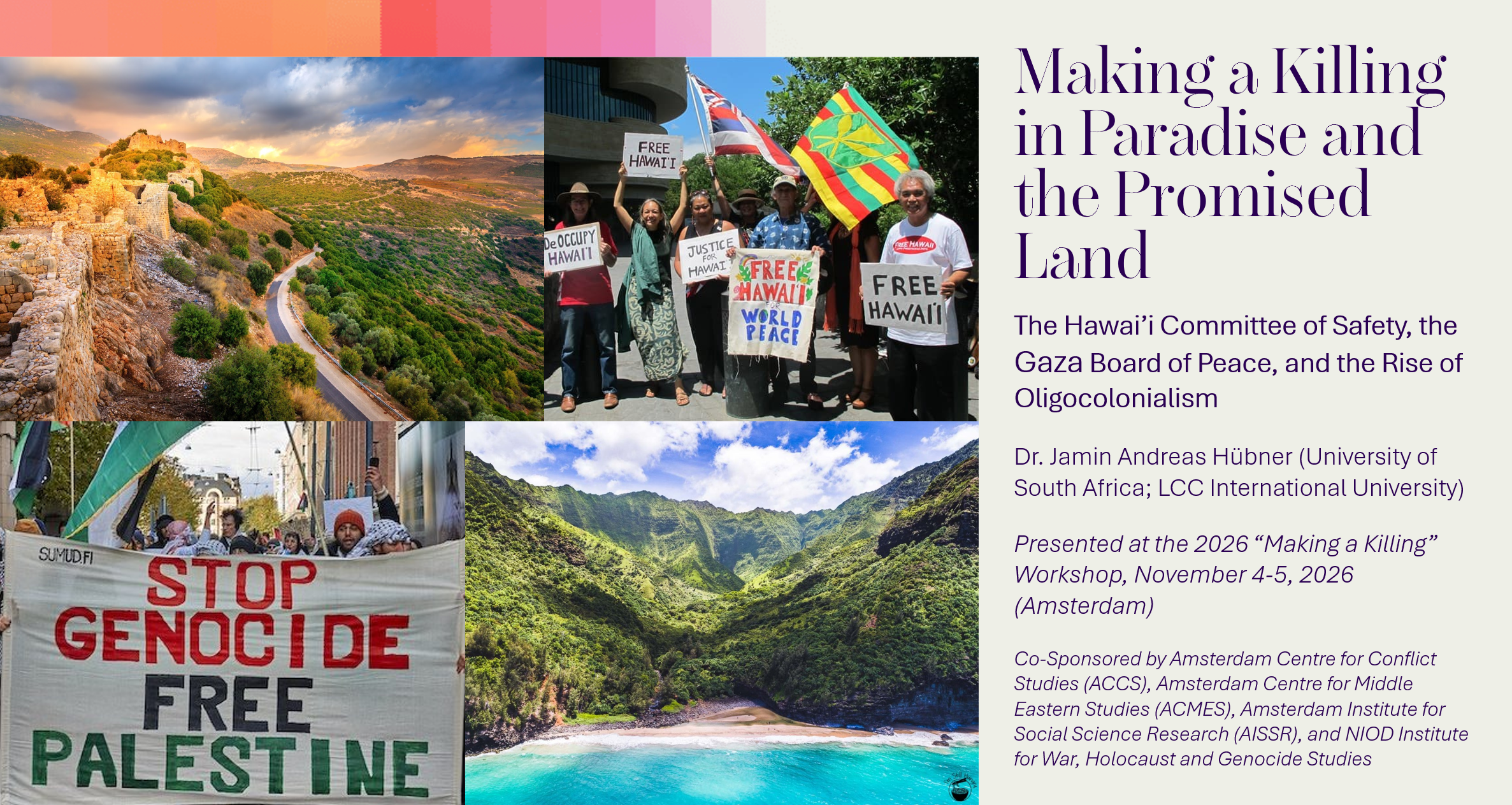
If it gets accepted, it will be published in a special edition of the journal called “Making a Killing: The Political Economy of Genocide in Gaza.” I look forward to meeting several scholars next week who are attending – and hearing the keynote by Martin Shaw.
I have two other articles pending at Middle East Critique, one of them for a special edition on American Zionism. I’m writing about the role of Christian higher education and its influence in American politics.
I’m finding Kimi and Claude Opus both a great help and a crutch with many of these projects. A help in the research, formatting, and structuring, and occasionally, drafting. But since drafting is too risky, I have to still pound out the words and do the mental labor myself. It’s a crutch in that its easy to be over reliant and lazy and spend too much time fiddling with the machinery when I should just be reading the primary sources. This is, I think, the great temptation of scholars in this era. And pangram and other AI detectors are sorting the wheat from the chaff when it comes to academic integrity.
I do think that 2000-2020 was the Golden Age of Scholarship. By this time, everyone knew how to use the internet and word processors. Global research databases were up and running with searchable indices. Historically, in a tremendously privileged period allowing more critical thought in globalized contexts. And no AI. It was a period of great connecting and great research. Sigh.